Executive Summary
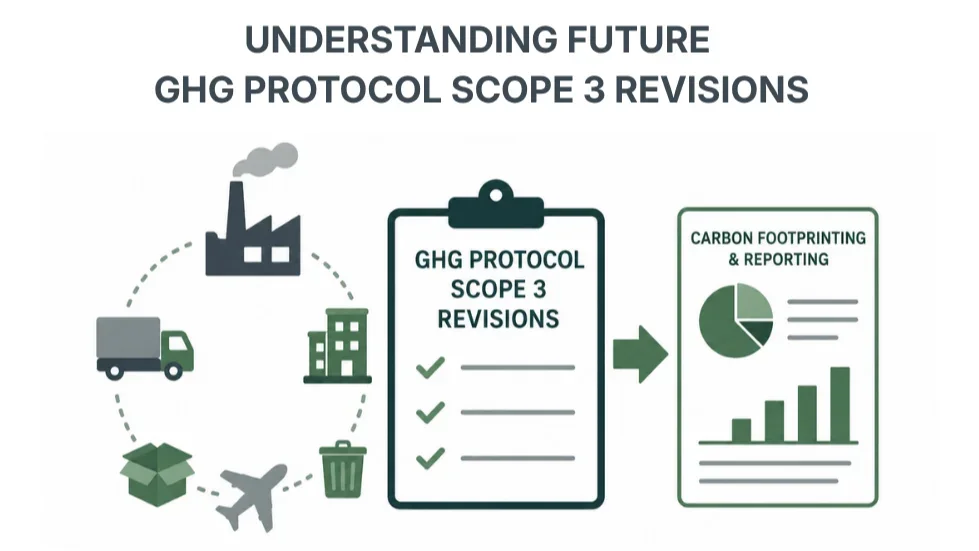
The Greenhouse Gas (GHG) Protocol has published a Phase 1 Progress Update outlining proposed revisions to the Scope 3 Standard. These revisions are not yet active requirements and remain under development, subject to further review, public consultation, and final approval.
However, the proposals provide a strong indication of the future direction of Scope 3 reporting and carbon accounting. Organisations should begin assessing the potential impact of these changes on their reporting processes, data collection strategies, supplier engagement programmes, and carbon accounting methodologies.
The overall direction of travel is towards increased transparency, greater use of primary data, improved data quality, more comprehensive reporting boundaries, and enhanced verification.
Current Status
It is important to note that the proposed revisions are not currently in force.
The March 2026 document is a progress update produced by the Scope 3 Technical Working Group and explicitly states that it is not a GHG Protocol Standard. All proposals remain draft recommendations and are subject to change before any formal public consultation and final approval process.
At present, companies should continue reporting in accordance with the existing Scope 3 Standard while monitoring developments closely.
Key Implications for Scope 3 Reporting
1. Increased Transparency Around Data Quality
One of the most significant proposed changes is a requirement for companies to disclose the type of data used to calculate Scope 3 emissions.
Currently, organisations often report a single Scope 3 figure without clearly distinguishing between:
Supplier-specific emissions data
Product-level emissions data
Industry-average emission factors
Spend-based estimates
Under the proposed revisions, companies would be required to disaggregate emissions according to data type.
Practical Implications
This would make it easier for stakeholders to assess the reliability of reported emissions and distinguish between high-quality primary data and broader estimation techniques.
As a result, organisations relying heavily on spend-based calculations may face increased scrutiny, while those collecting supplier-specific and product-level data may be viewed more favourably.
2. Stronger Expectations for Data Improvement
The proposals encourage organisations to establish measurable targets for improving Scope 3 data quality over time.
Examples include:
Increasing the proportion of emissions calculated using primary data
Expanding supplier engagement programmes
Tracking the percentage of suppliers providing emissions information
Establishing year-on-year improvement targets
Practical Implications
Carbon accounting is expected to evolve from a periodic reporting exercise into an ongoing data management and supplier engagement process.
Organisations should expect growing pressure to demonstrate continuous improvement in data quality rather than maintaining static reporting approaches.
3. Greater Focus on Verification
The draft revisions introduce additional disclosure requirements relating to verification.
Where Scope 3 emissions are independently assured, companies may be required to disclose whether their inventory is:
Fully verified
Partially verified
Not verified
Practical Implications
Although verification is not proposed as a mandatory requirement, it is likely to become an increasingly important indicator of credibility and robustness.
Investors, customers and regulators may place greater confidence in inventories that have undergone external review.
4. More Representative Supplier Data Requirements
The proposals seek to limit the use of highly aggregated supplier emissions data.
In particular, corporate-level emissions data from diversified suppliers may no longer be considered appropriate for allocating emissions to specific products or services.
Practical Implications
Companies may increasingly need access to:
Product-level emissions data
Process-level emissions data
Facility-level emissions data
This would place additional emphasis on supplier engagement and primary data collection throughout the value chain.
5. More Comprehensive Scope 3 Boundaries
A major proposed change is the introduction of a requirement that companies report at least 95% of required Scope 3 emissions.
Under this proposal:
At least 95% of required emissions must be included.
No more than 5% may be excluded.
Any exclusions must be disclosed and justified.
Practical Implications
This would significantly reduce the ability to omit categories based on assumptions regarding materiality or relevance.
Companies would need to estimate a much broader range of emissions sources and maintain clear documentation supporting any exclusions.
6. Expansion of Scope 3 Boundaries Through a New Category 16
The proposals introduce a new Category 16 covering certain "other value chain activities" and facilitated emissions.
This is intended to address activities that currently fall into a grey area where companies may influence emissions without directly owning or purchasing the associated assets or activities.
Practical Implications
Certain business models may face additional reporting expectations in the future, particularly where organisations facilitate emissions-generating activities without directly controlling them.
Overall Assessment
Although these revisions are not yet mandatory, they clearly indicate the future direction of Scope 3 reporting.
Organisations should anticipate a future reporting environment characterised by:
Increased transparency regarding calculation methodologies and data quality
Greater reliance on supplier-specific and product-specific data
More comprehensive inventory boundaries
Improved disclosure of exclusions
Stronger expectations around assurance and verification
Ongoing improvement of Scope 3 data quality
For organisations involved in carbon accounting, ESG reporting, product carbon footprinting, supplier engagement programmes or sustainability consulting, the proposed revisions suggest that detailed primary data collection will become increasingly important, while reliance on broad spend-based estimation approaches is likely to become less acceptable over time.
Recommendation
While no immediate changes are required, organisations should begin preparing by:
Reviewing current Scope 3 calculation methodologies.
Assessing the proportion of emissions based on primary versus secondary data.
Identifying key supplier engagement opportunities.
Improving documentation of assumptions and exclusions.
Considering future assurance and verification requirements.
Monitoring the GHG Protocol consultation process and subsequent standard updates.
Early preparation will reduce future compliance risk and place organisations in a stronger position should these proposals be adopted in the final revised Scope 3 Standard.
Are you confident in your Scope 1, 2 and 3 measurements? Or haven't you started measuring your footprint yet?
To help, we're offering a complimentary Carbon Measurement & Scope 3 Readiness Review, covering:
· Whether you're currently measuring emissions, and where the gaps are
· Where your inventory relies on spend-based or industry-average estimates
· Gaps in supplier-specific or product-level emissions data
· Practical next steps to improve data quality and reporting readiness
The aim is to give you a clear, actionable snapshot of where you stand and what to prioritise without any obligation.
Interested in learning more? Book a 30-minute slot via my Calendly https://calendly.com/sam-cande-greengage/30min
or email sam.cande@greengage.solutions